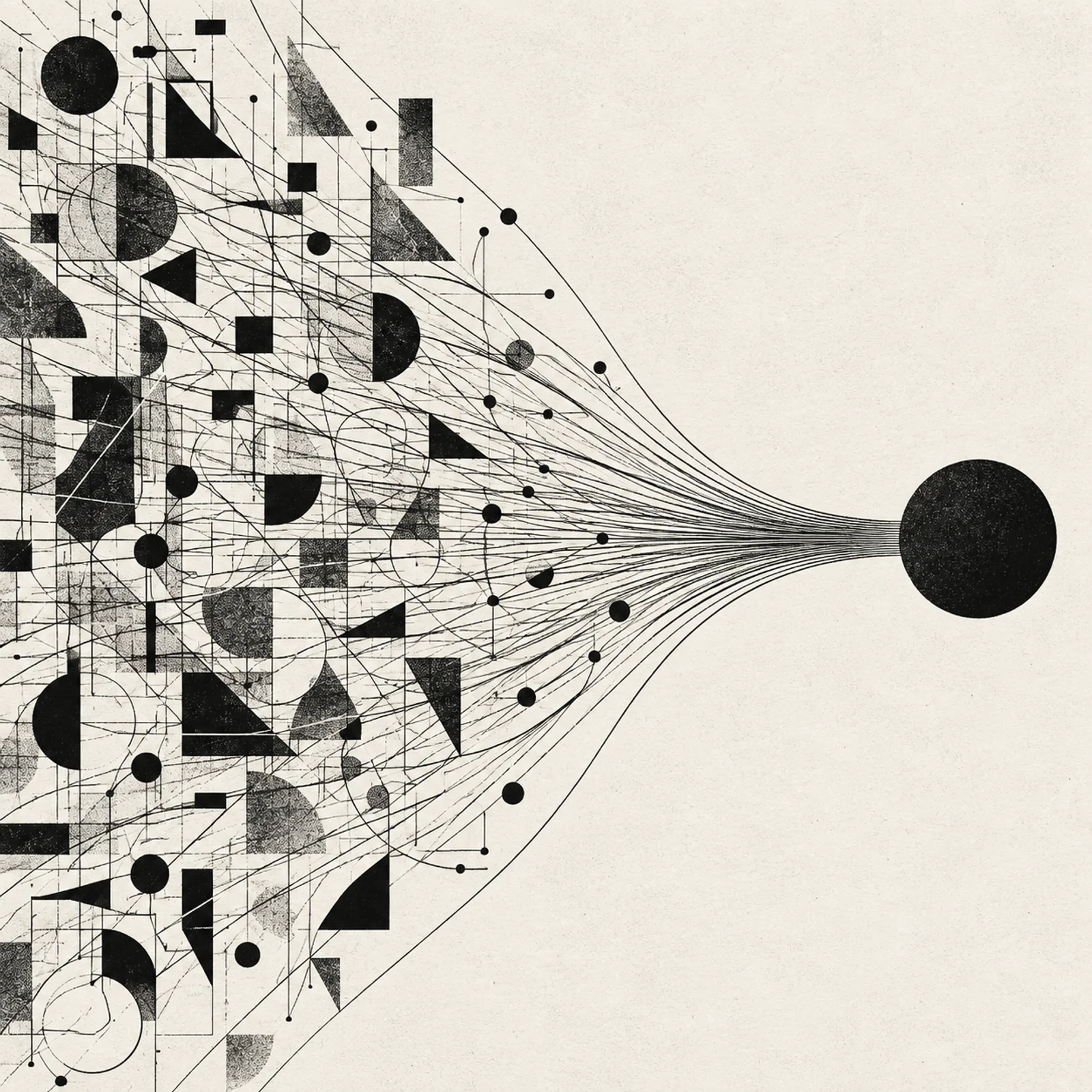
Creative teams are usually rewarded for what they add. More concepts make a presentation look productive. More features make a proposal feel ambitious. More references make a direction appear researched. Yet the work audiences remember is often defined by the opposite capacity: the ability to remove everything that does not strengthen the central idea.
Subtraction is difficult because additions are visible while restraint is not. A stakeholder can point to a new section, animation, or message. It is harder to point to the confusion that never reached the screen. This creates a bias toward accumulation. Every reviewer protects one concern, and the final work becomes a record of internal negotiation rather than a clear experience for the audience.
More options can hide the absence of judgment
Exploration matters at the beginning of creative work. Teams should test different frames, structures, and visual languages before committing. The mistake is treating every explored possibility as something that deserves to survive. Divergence produces material; judgment turns that material into a position.
A useful creative review should therefore ask more than “What else could we add?” It should ask which idea is carrying the argument, which elements merely repeat it, and what the audience must understand first. If everything is emphasized, nothing is prioritized. If every audience receives its own message, the work may no longer have a recognizable point of view.
Subtraction needs a shared standard
Removing elements by instinct alone can become another form of taste making. Strong teams connect subtraction to an explicit standard. Does this element improve comprehension? Does it help someone act? Does it make the identity more distinctive? Does it provide evidence the argument cannot stand without? When the answer is no, the burden of proof should shift toward keeping it.
This standard changes the politics of feedback. Instead of defending personal preferences, people can examine the role each element performs. A legal requirement may need to stay even when it complicates the composition. A decorative treatment may need to leave even when everyone likes it. The decision becomes less about who has the strongest opinion and more about what the work is responsible for doing.
Leaders must protect the final decision
Subtraction also requires authority. A team cannot create a coherent outcome when every participant has veto power but nobody owns the final hierarchy. Creative leaders need to listen broadly, distinguish evidence from anxiety, and make the decision that closes the work. Consensus can inform the process without becoming the design method.
The practical tool is a short hierarchy written before production: one primary idea, a small number of supporting points, and a list of details that can move elsewhere. Revisit that hierarchy when the work grows. The question is not whether the new material is valuable in isolation. The question is whether it improves the whole.
Restraint is a form of confidence
Work that has been carefully reduced often feels calmer, but calm should not be confused with emptiness. The remaining elements carry more responsibility. Typography must be precise. Language must be specific. Space must establish rhythm rather than merely fill an absence. Subtraction raises the standard of execution because there is less noise available to hide weak decisions.
The result is not minimalism as a style. It is clarity as an operating principle. Creative teams become more original when they stop treating abundance as proof of value and start treating selection as the work itself. What they remove is evidence that they know what the idea is.